Brook Street Centre History
Building History
Thanks to Knutsford Heritage Centre for helping fill the gaps
THE LAND
Brook Street, Knutsford, (A537) leads from Adams Hill, through Macclesfield towards Buxton.

Title Map, 1836-1851
One hundred and seventy years ago, Tithe Maps identify a small number of houses dotted along Brook Street close to the junction of Hollow Lane.
The remainder of the land was described as croft, garden, and pasture on the west side of Brook Street and a sand field and nursery on the east.
Over the coming years some houses and cottages were demolished either for road widening, or because they were in poor state of repair, or derelict, whilst other new buildings were erected, e.g. the Congregational Church, Manse and Schoolroom.
THE CHURCH, Date of Image: 1900 – 1909
The Congregational Church was built in 1865 and boasted a spire, school room and hall, together with the Minister’s House, all situated on Brook Street.
When the congregation dwindled and could no longer maintain the church, it closed in 1937 and was demolished in July 1948. The schoolroom was used for a variety of purposes thereafter and latterly as a knitwear factory until a new knitwear factory was constructed on the site of the church in 1973. Today it is the site of a modern office block known as Mere House.
BUSINESSES IN BROOK STREET Date of Image: 1900 – 1909


You can just make out the period advertisements on the gable end of the shop, Arthur Dyble, Oil and Lamp Dealer. Other businesses on Brook Street listed in the Knutsford South 1908 Ordnance Survey Map are: Mary Newton Blacksmith; William Webb Grocer and Post Office; Joseph Gidman Knutsford Mineral Water Works; Hugh Bradbury Pig Dealer; Joseph Bradbury Cab Proprietor; John William Baird Builders’ Merchant; and Henry & Julius Caesar Rustic House Builders. So what of the building later to become known as the Brook Street Club?
ORIGINS OF THE BROOK STREET BUILDING
1893 – 1910: Knutsford Mineral Water Works Company
The origins of the building go back to 1892/93 when Joseph Gidman commissioned the construction of a purpose-built mineral water bottling plant, and in 1893 he opened his Knutsford Mineral Water Works Company.
NB: At this time, there were around 25 pigsties in the town and there may have been one on or near the of site for the building of Joseph Gidman’s Water Works company (Hugh Bradbury, Pig Dealer). Also, Redfern Brothers building yard was situated to the rear of the Water Works building.
Among the guests invited to the opening ceremony were three members of the Caldwell family, but the honour of setting the machinery in motion and drinking the first bottle fell to the Vicar, the Rev. Henry Barnacle. He reflected on the changes in Knutsford, remembering that in the years past the brick setter’s trowel was heard only when a chimney fell down but now new villas were built as local enterprise flourished. That though, he said, could only mean employment for a large number of people. On hot, summer days children would call in to buy pop direct from the production line.
In 1910 the firm sold out to Howells, and later it became Horrocks and Mackeral before finally closing down.
FORMATION OF THE CLUB
1910/1911 – 1974: Knutsford Liberal Club and Party Headquarters
Following the closure of the Mineral Water Works Company on Brook Street the building was purchased by staunch supporter of the Liberal Party, Mr Cowburn from Booths Hall. Mr Cowburn immediately set about transforming the interior of the former bottling plant into suitable space for the Knutsford Liberal Party Headquarters and Social Club, which previously had met in first floor offices of the General Post Office on King Street.
The Billiards and Social Club
The Club have score boards dating back to 1885, i.e. almost 10 years before the G.P.O. building was erected, so where did the Club meet prior to this?
Research indicates there was one club in existence where members played billiards and a form of pool, and this was the Knutsford Club which had been meeting at premises on Tatton Street. It is suggested that the 1885s score boards refer to the Knutsford Club.
The Knutsford Club had been in existence since at least the early 1870s. Kelly’s 1874 directory lists Trumpet Major William Smith (a survivor of the Charge of the Light Brigade) as its Manager (jointly with his wife), and Alfred Cutter as Honorary Secretary. At Trumpet Major Smith’s inquest into his death, Albert Wright was called and gave his occupation as billiard marker at the club. The club had a newsroom providing papers and magazines and where card, draughts and dominoes were played, but its main attraction was pool and billiards.
In 1895 there was discord among the members at the Knutsford Club and a breakaway club was formed calling itself The Cranford Billiards and Social Club. The cause of the split is unknown – but it seems to have been the more professional men who moved to the new Cranford Club, doctors and solicitors, while the tradesmen continued at the Knutsford Club on Tatton Street. The newly formed Cranford Club Secretary was Walter Scott, and in 1895 the club was registered at the newly built Post Office Buildings, in King Street.
The post office building was built in 1894 by Mr Thrutchley and leased to the G.P.O. Richard Harding Watts made alterations to the building when he initiated the Cranford Billiards and Social Club on the first floor.
Origin and history : Brook Street Club, Knutsford
In its early years, the Cranford Club attracted a membership of around 100, but when the Steward, a Mr Windle, left in 1905, (his successor was the Steward from the Knutsford Club on Tatton Street),
membership fell and action had to be taken. Dr Fennell, a keen billiards player, wanted the Cranford Club to continue, so he discussed with Alan de Tatton Egerton, the new Lord Egerton, whether the old convalescent home near the entrance to Tatton Park could be used as a Club House.
A meeting was called and in 1911 both the Knutsford Club and the Cranford Club agreed to amalgamate as neither could afford to run their clubs separately. Whether the two clubs went ahead with the merger is unknown, because within a very short space of time both Clubs went their separate ways – Cranford Club needed to find a new venue, and the Knutsford Club needed a new club partnership.
The Parish Church Men’s Institute Club (who met in a small room at the infants’ school on Silk Mill Street) were looking for larger premises, and it made sense for that club to merge with the Knutsford Club who had large premises on Tatton Street. In 1926, they became known as the Knutsford Recreation Club.
Note: The Parish Church Men’s Institute offered a variety of social events including a Christmas Billiards Cup, and a draughts competition.
In 1947 Lord Egerton bought the Knutsford Recreation Club premises for £2,600 and in 1954 he sold it to the Club Trustees for £800. This is when the Club changed its name to The Tatton Club. There is a “Presidents Board” on the wall of the club with names going back to 1926 and is headed “The Tatton Club – Formerly Knutsford Recreation Club”.
The Liberal Party
In 1911, thanks to Arthur Cowburn’s purchase of the former Knutsford Mineral Water Works company, the Knutsford Liberal Party was able to move from its old meeting rooms above the Post Office on King Street to its new premises on Brook Street. There, under Mr Cowburn’s guidance, they set up Party Headquarters and also a social and recreation space. They then welcomed the former Cranford Club members to use its facilities and very soon a snooker section was formed.
Within a few years World War One broke out, and during the war the building operated as a soup kitchen and offered storage and warehouse space. It is even rumoured that the cellar was earmarked as a morgue! Later there would be a memorial scroll in the building remembering eleven WW1 Liberal Club members who died. It also listed the names of ninety seven men who served and returned.
Following Arthur Cowburn’s death in the early 1950’s, his two sons took over the estate and split the club into two parts – upstairs operated as the Liberal Party Headquarters and downstairs was the Liberal Social Club.
The Liberal Club holds an important part in creating the league in that it donated the Division 1 Winners Trophy that was first won in 1951-52 by “Mere A”. The trophy is still in use today. Many of the players who formed the league played in local matches in 1948 before the requirements of National Service disrupted things somewhat during the war years.
From the early 1950s, Knutsford Photographic Club held regular meetings here, and from the late 1950’s to the early 1970’s the Knutsford Chess Club used the cellar on a regular basis.
In the 1960s/70s, Knutsford Brass Band rehearsed in the Band room on the top floor. The Club has also been home to Knutsford Operatic Society, as well as being a music venue in more recent years.
Brook Street Club
In 1974 the building ceased to operate as Liberal Party Headquarters and in August of that year the building was bought by its members for the princely sum of £3,000. The biggest project the Liberal Club undertook was the bar extension in 1979.
On 1st July 2004 the members changed the name of the club from the Liberal Club to the Brook Street Club. This was done to remove any suggestion of a political leaning in order to try to obtain a grant from Manchester Airport to make improvements to the building – sadly this failed.
During its more recent history, the Club hosted two outstanding events –
Dennis Taylor, who was contracted to the Club’s brewery, visited the Club in the early 1980’s.
He took on 8 players from the Liberal Club, giving each player 30 points start and lost only once when Paul Westbury beat him “Taylor had the final pink over the yellow bag, went to screw it back for the black, jumped the white over the pink and into the pocket. Westbury stepped in.”
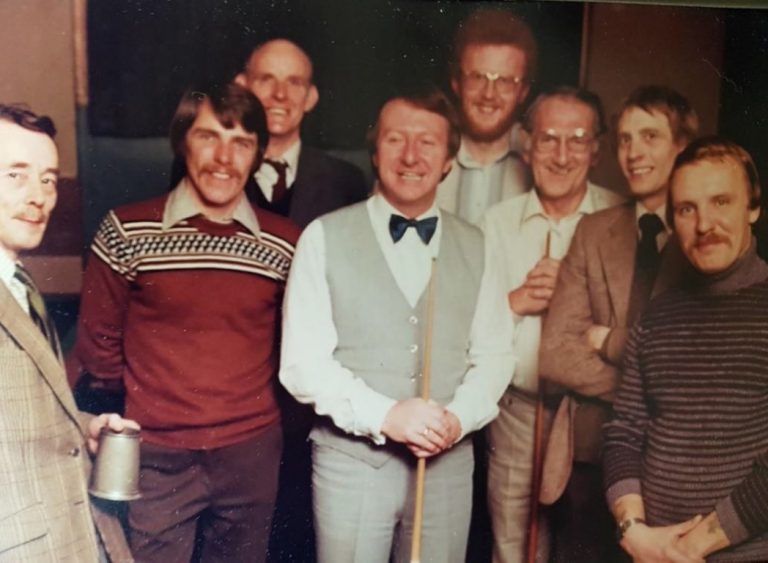
Names left to right: David Walters, John Dale, Fred Rayner, Dennis Taylor, Gareth Williams, Sid Jones, Worrol Rayner, Paul Westbury.
In 1995 Willie Robinson brought Alex Higgins into the club for a frame of snooker where he signed the Visitors book “Alex Higgins Snooker Champion”.
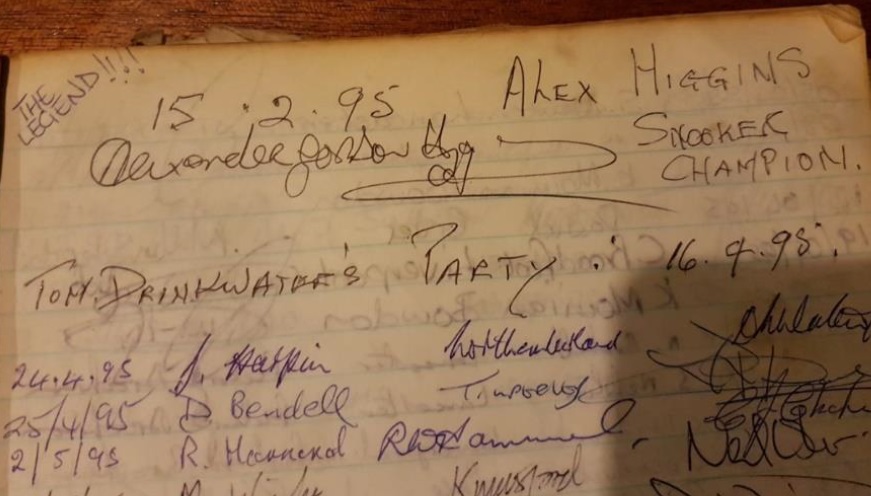
Despite numerous initiatives, including staging many music events and the hiring out of rooms for different activities, which saw the Club through the new millennium, an ageing and declining membership and lack of funds meant the Club’s days were numbered. In 2019 the Club was sold on once more and the two remaining Snooker Teams moved to The Tatton Club in 2019-20.
1870’s New Snooker/Billiards club formed called “The Knutsford Club”, meets in Tatton
Street.
1892/93 New building erected on Brook Street for Joseph Gidman of the Knutsford Mineral Water Works Company.
1894 Post Office building erected on King Street by Mr Thrutchley. Later, alterations made by Richard Harding Watts.
1895 A new club “The Cranford Club” breaks away from the Knutsford Club. Meets 1st floor of new Post Office Buildings, King Street. Secretary Walter Scott.
1910/11 The Mineral Water Works bottling plant closes. Building purchased by Mr Arthur Cowburn for Knutsford Liberal Party HQ.
1911/12 Cranford Club has a new venue – Liberal Party HQ, Brook Street.
1974 Liberal Party ceased to operate and Club sold to members for £3,000.
2004 Change of name from Liberal Club to Brook Street Club.
2019 Brook Street Club closes and members disband. New owners take over and renovate. Snooker teams transfer to the Tatton Club.
2021 Brook Street Club re-opens as a Yoga and Wellness Studio.
Guardian Newspaper Snips
Every Logo Tells a Story
The logo once used by Caldwell’s nursery in Chelford Road showed King Canute seated in regal dignity commanding the waves (obviously not a snap shot of his Knutsford visit).
But it was not designed for the nursery business at all. Joseph Gidman commissioned the original design for his mineral water works in Brook Street, which is now home to The Liberal Club.
The works were officially opened in 1893. Among the guests invited to the ceremony were three members of the Caldwell family. But the honour of setting the machinery in motion and drinking the first bottle full fell to the Vicar, the Rev Henry Barnacle.
He reflected on the changes in Knutsford, remembering that in the years past that the brick setter’s trowel was heard only when a chimney fell down but now new villas were built as local enterprise flourished.
That, though, he said, could only mean employment for a large number of people.
On hot, summer days children would call in to buy pop direct from the production line.
Occasionally old, green, glass bottles are found with the King Canute logo embossed. I wonder what potash and Lithia waters tasted like?
The Gidmans lived in the nearby Brook Cottage, which is now threatened with demolition.Daughter Sylvia, who was crowned Knutsford’s May Queen in 1906, later had a
distinguished teaching career in Canada.
About 1910 the firm became Howells, and later Horrocks and Mackeral, before
closing down and yielding their logo to Caldwells.
Brook Street Club in Knutsford ‘no longer financially viable’
NEXT month will see the end of an era with the closure of a club which has been part of ‘Knutsford’s fabric’ for more than a century.
Brook Street Club is a live music and comedy venue, as well as being home to a social snooker club and offering martial arts classes.
However it has been running at a loss over recent years, and members voted reluctantly in October that it should close.
The club will shut at the end of March, when its snooker teams will play their last games of the season and host a small, informal gathering of members on Friday, March 29 to mark the closure.
The club told the Guardian: “Good quality community assets are a dwindling feature of many of our towns and cities, and Knutsford is no different.
“Closure of many of the town’s pubs or their conversion to restaurants, along with the reduction of social clubs, means vital community clubs with good quality premises are assets that are rare and vulnerable.
“Brook Street Club is such an asset, and we’ve been working with a range of partners to attempt to protect the future of the club.
“It’s a members-based non-commercial club run on a volunteer basis that’s been part of the fabric of Knutsford for over a century.
“The Knutsford social scene is vibrant enough to support a good mix of commercial hospitality venues and the town’s member clubs, so there is space for good mix of commercial and community local venues.
“However members’ clubs such as Brook Street are faced with the challenges of changing social habits, and many have dwindling and ageing memberships with no natural source of new, younger members.
“Brook Street Club was previously a very successful members club with a hard-working group of officers and committee members supported by a large group of members.
“In recent years though, the club has been trading at a loss and has only been able to operate by drawing on the club’s reserve funds.
“The club is now in a position where the reserves cannot support the club for more than the next year, and at a special general meeting in October the members voted overwhelmingly for the club to cease operations and close.
“The decision was taken with reluctance but based on a recognition of the reality of the situation we face.
“It’s the end of an era and we’re sad to see it close, but the club is simply no longer financially viable.”
The club said the two snooker teams were transferring to Tatton Club and the martial arts club which used the function room on a regular basis was seeking a new home.
It added that it was confident that its partners who provided comedy and music events including LOL Cheshire and the Knutsford Music Festival would secure alternative venues.
Knutsford Liberal Club 1914-1919 War Memorial
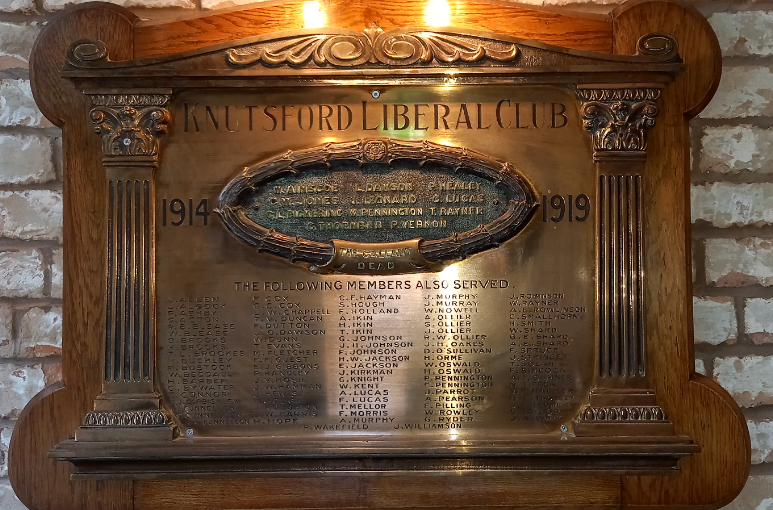
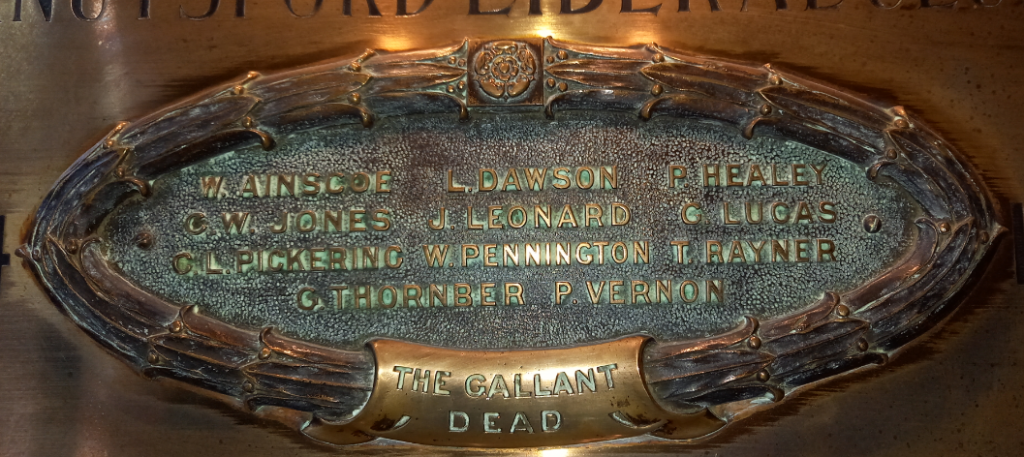
THE GALLANT DEAD
Information provided by Tony Davies – The Knutsford Lads who never came home
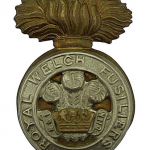
John Leonard was a married man with three children. He set up home in Swinton Square, Knutsford, later moving to 28, King Street. He joined the Royal Welch Fusiliers. He was killed in action on 4 August 1917. His body was never recovered. He was 36 years old.
George Lucas was the son of a joiner. He was one of six children and lived on Tatton Street, Knutsford. He died during a training exercise at Bidston Camp nr, Birkenhead on 09 June 1916, when a grenade went off prematurely. He is buried in Knutsford Cemetery. He was 20 years old.
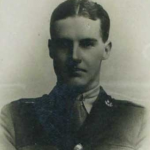
Charles Leigh Pickering was the son of an importer and was born in Altrincham but moved to ‘Bramley’, Knutsford. He initially enlisted in the Cheshire Regiment but later transferred to the Royal Flying Corp. His aircraft was shot down during a ‘dog fight’ in the Basra area of Iraq on 15 April 1917. He died as a result of his wounds.
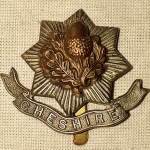
William Thompson Pennington was born in Mobberley and was the son of a labourer. He became a domestic gardener. He joined the Cheshire Regiment. In 1916. He died for wounds he received in battle on 23 October 1918 – just 19 days before the armistice was signed. He was 35 years old.
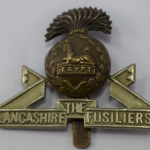
Thomas Rayner was born in Davenham, the son of a house painter. He was one of seven children. He became a gardener. He joined the Lancashire Fusiliers and was killed in action 11 August 1917. He was 24 years old.
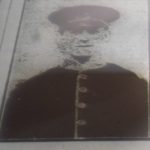
George Thornber was born in Denton, Lancashire but came to live in Crosstown. He joined the Cheshire regiment and went to France on 15 February 1915. He was killed in action on 18 October 1915 during the Second battle of Ypres.
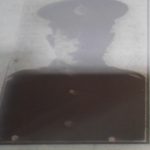
Percy Vernon was the son of a gardener and lived at 116, King Street, Knutsford. He became a cabinet maker. He enlisted in the Royal Engineers on 28 December 1914 (aged 18). He was wounded in action on 18 October 1915 and succumbed to those wounds five days later. He was 19 years old. His brother Vernon was also lost during the war.